

If You Can Hold on for 100 Seconds, You’ll Earn $100. The Most Creative Advertising Campaigns
 InfoSearched
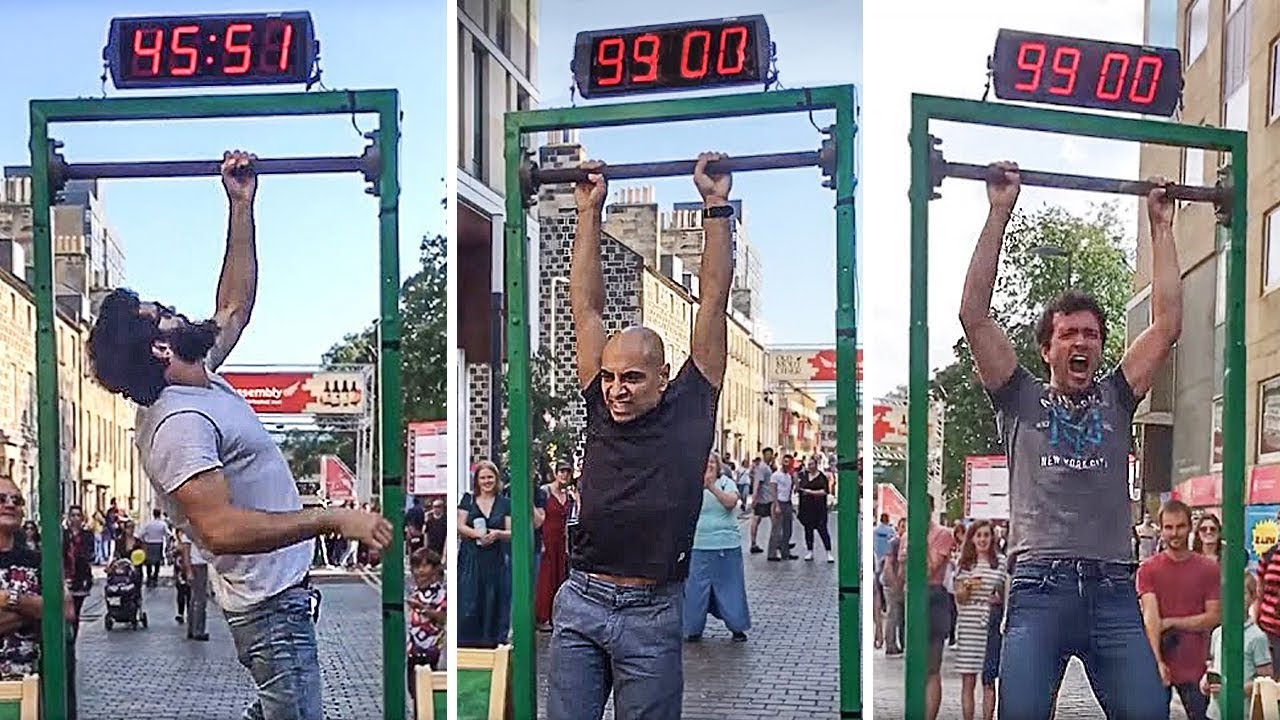
A pull-up bar, a $100 bill taped to a sign, and a crowd that never sees the catch coming.
It looks like free money: hang from a bar for 100 seconds, walk away with $100. #Mind Warehouse’s video “If You Can Hold on for 100 Seconds, You’ll Earn $100” breaks down why almost nobody actually collects, and how the same booth setup has become one of the most reliable street-hustle marketing gimmicks in the country. The trick isn’t strength — it’s a rigged bar that turns a simple grip test into a wrist-destroying trap within a minute.
- The “hang challenge” charges a small entry fee for a shot at a $100 payout for hanging 100 seconds from a pull-up bar, commonly set up at state fairs, tourist strips like Hollywood Boulevard, and guerrilla brand pop-ups.
- The bar’s core is loaded with loose ball bearings, letting it spin freely under the participant’s weight, which forces the wrists open and burns out forearm grip in roughly 30 to 60 seconds.
- Because the payout is so rare, operators collect steady entry fees from a stream of overconfident challengers while barely ever handing over the $100.
Bar Exam Difficulty Factors
A standard static pull-up bar is a grip endurance test anyone who works out regularly can usually survive well past 100 seconds. The hang-challenge bar isn’t static. Ball bearings inside the housing let the whole bar rotate freely the instant weight is applied, so a hanger can’t lock their wrists into a stable position the way they would on a fixed bar. Every small movement — shifting body weight, adjusting grip, even breathing — sends the bar rolling, and the forearms have to fight that rotation constantly instead of just holding a static load.
That constant micro-correction is what drains grip strength so fast. Instead of one sustained isometric hold, the body is doing continuous small stabilizations, which taxes the forearm flexors far quicker than a normal dead hang. According to the breakdown in the video, most challengers who feel confident walking up to the bar are done within 30 to 60 seconds, less than half the time needed to win.
The Business Behind the Booth
The economics are simple and brutal. Charge a few dollars per attempt, let the physics do the work, and rarely if ever pay out the $100. Because the challenge looks so easy — it’s just hanging, not lifting — vendors get a steady line of confident passersby willing to bet a small fee against what feels like an obvious win. That volume of small entry fees against a rare $100 payout is what makes the booth profitable wherever it’s set up, from carnival midways to sidewalk activations.
The bar isn’t testing your strength — it’s testing whether you notice it’s spinning before your grip gives out.
It’s a classic curiosity-gap setup: the challenge is visible, the prize is specific and tempting, and the mechanism that makes it nearly unbeatable is hidden in plain sight. That combination of visible stakes and hidden trick is exactly what turns a street booth into a magnet for foot traffic and, increasingly, into shareable video content.
Part of a Bigger Playbook
The hang challenge is just one entry in a wider category of ambient and experiential marketing stunts the video compiles — interactive bets, public spectacles, and curiosity-driven activations designed to pull crowds in and generate word-of-mouth or social shares far beyond whoever actually stops at the booth. These tactics lean on the same principle as good affiliate hooks or guerrilla promotions covered in pieces like Launching into Affiliate Marketing: A Guide: get attention cheaply, make the offer feel irresistible, and let the structure of the game do the heavy lifting on conversion or, in this case, entry fees.
Whether it’s a hang-challenge bar on Hollywood Boulevard or a branded stunt at a state fair, the appeal to organizers is the same low-cost, high-visibility math that also shows up in scrappier small-business growth stories, the kind detailed in 3 Steps To Starting A Home Business… — minimal overhead, maximum foot traffic, and a hook simple enough to explain in one sentence.
Next time there’s a $100 sign taped to a spinning bar on a boardwalk or a fair midway, the smart move is to watch someone else try it first — because within a minute, their forearms will tell you everything the sign won’t.




Smart Online Shopping
Launching into Affiliate Marketing: A Guide
A must hear report on gold and silver
Internet Business Ideas
5 KEYS TO BEING A GREAT DAY TRADER! RULES OF 36 YEAR VETERAN TRADER!