

 InfoSearched
Russell Brunson wants entrepreneurs to stop selling once and start selling five times to the same customer.
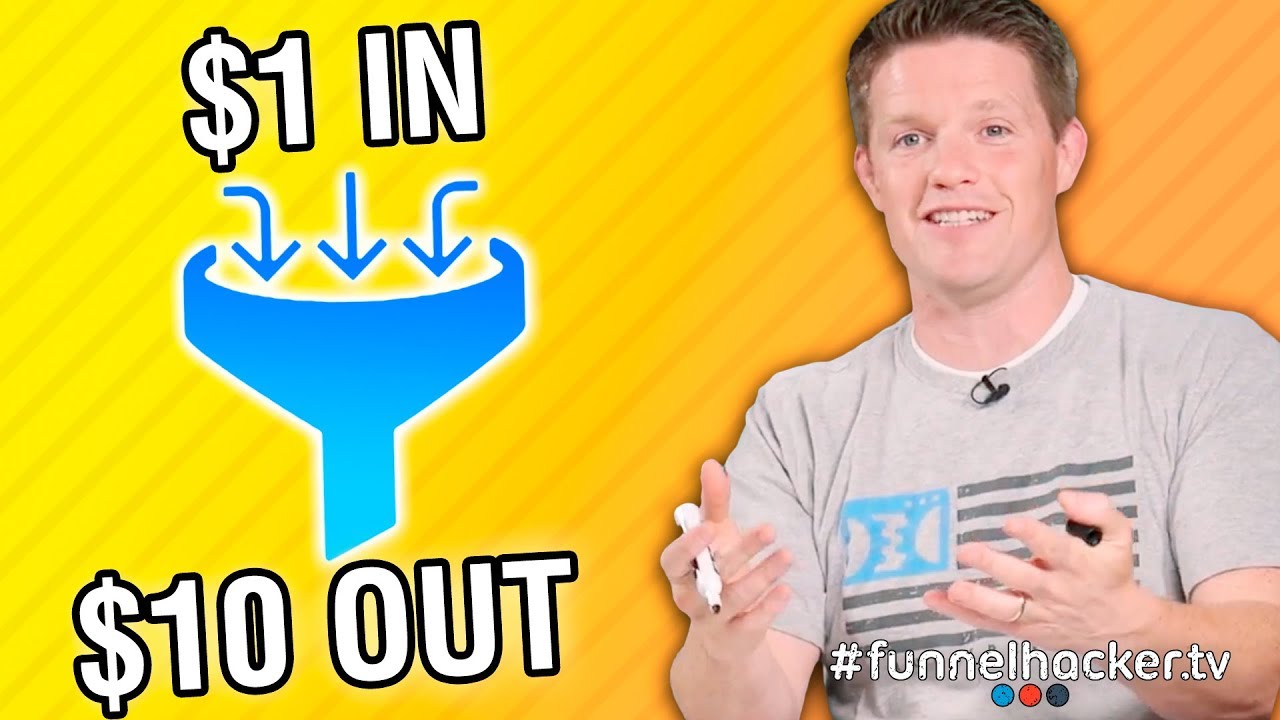
In his 2019 training “Do THIS to 10x Your Sales Funnels Profits,” ClickFunnels co-founder Russell Brunson lays out the mechanics he’s used to build a software company that topped $100 million in sales without taking outside venture capital. His argument is blunt: a static website or a single-product storefront leaves the vast majority of available profit on the table, and the fix isn’t more traffic — it’s a better-engineered funnel behind the traffic you already have.
- Brunson’s central thesis: whoever can spend the most money to acquire a customer wins, which means the real competitive edge is a funnel that raises average order value and lifetime value, not a bigger ad budget.
- He details specific backend mechanics — order-form bumps, One-Click Upsells, downsells, and a structured “Value Ladder” — that move buyers from a low-cost entry offer up to high-ticket products or recurring subscriptions.
- Brunson promotes “funnel hacking”: buying competitors’ front-end offers to study and replicate their backend email sequences, webinar funnels, and pricing so ad spend turns profitable immediately instead of after months of trial and error.
The Math Behind 10x
Brunson’s framing starts with a simple but uncomfortable question for most sellers: if two businesses spend the same amount on Facebook or Google traffic, whichever one extracts more revenue per customer can afford to outbid the other for that same traffic indefinitely. That’s the crux of his “spend the most to acquire a customer” line — it isn’t about having deeper pockets, it’s about building a backend that makes deeper pockets irrelevant. A funnel that only sells a single $27 product has a hard ceiling on what it can pay for a click; a funnel that layers bumps and upsells behind that same $27 offer might pull $80, $150, or more from the same buyer.
That gap between front-end price and total transaction value is where the “10x” in the video’s title actually comes from. Brunson isn’t proposing new traffic sources or a redesigned landing page — he’s proposing that the sales sequence itself, everything that happens after someone clicks “buy,” is where the profit multiplier lives.
Order-Form Bumps, Upsells, and the Value Ladder
The training breaks the backend into a few repeatable pieces. An order-form bump is a cheap, related add-on presented right at checkout — a small tick-box offer a customer accepts before they’ve even finished the primary purchase. From there, Brunson lays out One-Click Upsells: post-purchase offers that let a buyer add a second or third product without re-entering payment information, each one designed to lift the average order value in a single transaction.
Downsells catch the customers who say no to an upsell by presenting a smaller, cheaper version of the same offer rather than letting that revenue disappear entirely. Strung together, these steps form what Brunson calls a Value Ladder — a deliberate path that starts with a low-friction entry product and escalates toward higher-ticket items or continuity subscriptions, including ClickFunnels’ own recurring software plans, which anchor the platform’s business model.
Whoever can spend the most money to acquire a customer wins.
Funnel Hacking as a Shortcut
Rather than building offers from a blank page, Brunson advocates “funnel hacking” — literally becoming a customer of a competitor’s front-end offer, then studying every email, upsell, and webinar pitch that follows. The goal is to skip the guesswork of testing sequences from scratch and instead adapt proven backend structures that are already converting in the same market. It’s a research method as much as a growth tactic, and Brunson treats it as the fastest route to a funnel that’s profitable from the first sale rather than one that needs months of split-testing to break even on ad spend.
This same instinct — study what’s already working before spending on traffic — shows up across his broader teaching on generating and qualifying leads for a website, where the emphasis is consistently on what happens to a visitor after the click, not just how the click was earned.
Backend Infrastructure Outperforms Frontend Interfaces
Brunson’s larger point, restated across most of his 2019 material, is that entrepreneurs chase traffic and conversion-rate optimization while ignoring the far bigger lever sitting behind the checkout button. A funnel with a mediocre landing page but a strong Value Ladder will often out-earn a beautifully designed page that stops selling the moment the first transaction clears. That’s also why he treats email marketing sequences as part of the backend machinery rather than an afterthought — the follow-up emails are what carry a buyer up the ladder toward the higher-ticket offer days or weeks after the first sale.
For anyone building an affiliate-driven business rather than selling a proprietary product, the same bump-upsell-downsell logic still applies to the commissions being chased, which is why Brunson’s funnel principles get cited well outside ClickFunnels’ own customer base, including in general breakdowns of how to structure an affiliate marketing business from the ground up.
Brunson closes the training the way he closes most of his 2019 content: with a challenge to actually build the sequence rather than just study it. The bump, the upsell, the downsell, and the Value Ladder aren’t separate tactics to try one at a time — they’re pieces of a single machine he says most sellers never finish assembling before they give up and blame the traffic.



Effective Direct Mail Campaigns
“How To Buy Out Your Business Partner (And How To Value Any Business)”
How to Find and Buy a Foreclosed Home
If You Want To Escape Poverty, DO THIS NOW! – David Bayer
What is Blockchain Technology? (In Simple Terms)