

 InfoSearched
Your desk was built for the average body — which means it probably wasn’t built for yours.
In “Ergonomics Expert Explains How to Set Up Your Desk,” a WSJ Pro Tip video shot by videographer Adam Falk, physical therapist Jon Cinkay walks through the fixes he gives patients every day at the Hospital for Special Surgery in New York. His argument is simple: office furniture is mass-produced for nobody in particular, so the burden falls on the worker to adjust the chair, the monitor, and the desk until the setup actually fits their frame. Skip that step, Cinkay says, and the small strains compound into the kind of chronic neck, back, and wrist pain that sends people to physical therapy years later.
- Cinkay is the coordinator of body mechanics at the Hospital for Special Surgery, and the video breaks his ergonomics protocol into discrete, testable adjustments rather than general advice.
- The chair setup calls for feet flat on the floor, knees bent at 90 degrees, and armrests positioned so elbows stay tucked against the torso instead of splaying outward — what Cinkay describes as avoiding “chicken wings.”
- Monitor placement gets its own specific rule: the screen should sit an arm’s length away with the top of the display lined up directly at eye level to keep the neck neutral.
Setting the Chair Before Anything Else
Cinkay starts at the base of the setup, not the screen. He has workers sit all the way back in the chair, plant their feet flat on the floor, and check that the knees land at roughly a 90-degree angle — a sign the seat height and depth are matched to that person’s legs rather than an average. Lumbar support comes next; most office chairs have an adjustable lumbar pad, and Cinkay says it should be dialed in to press into the small of the back so the spine keeps its natural curve instead of slumping forward by hour three.
Armrests get equal attention. Cinkay’s cue is that the elbows should stay close to the body while typing — if they’re flaring out to the sides, the armrests are set too wide or too high, and that posture loads the shoulders in a way that adds up over an eight-hour shift.
Elbows tucked in, not flared out like chicken wings — that’s the tell your armrests are set wrong.
The Monitor and the Eye-Level Rule
Once the chair is dialed in, Cinkay moves to the screen. His rule of thumb is distance and height together: the monitor should sit about an arm’s length from the face, with the top edge of the display aligned right at eye level. That combination keeps the user from craning the neck forward to read text or tilting the chin down for hours at a time, which is where a lot of desk-related neck strain originates.
Keeping the Essentials Within Reach
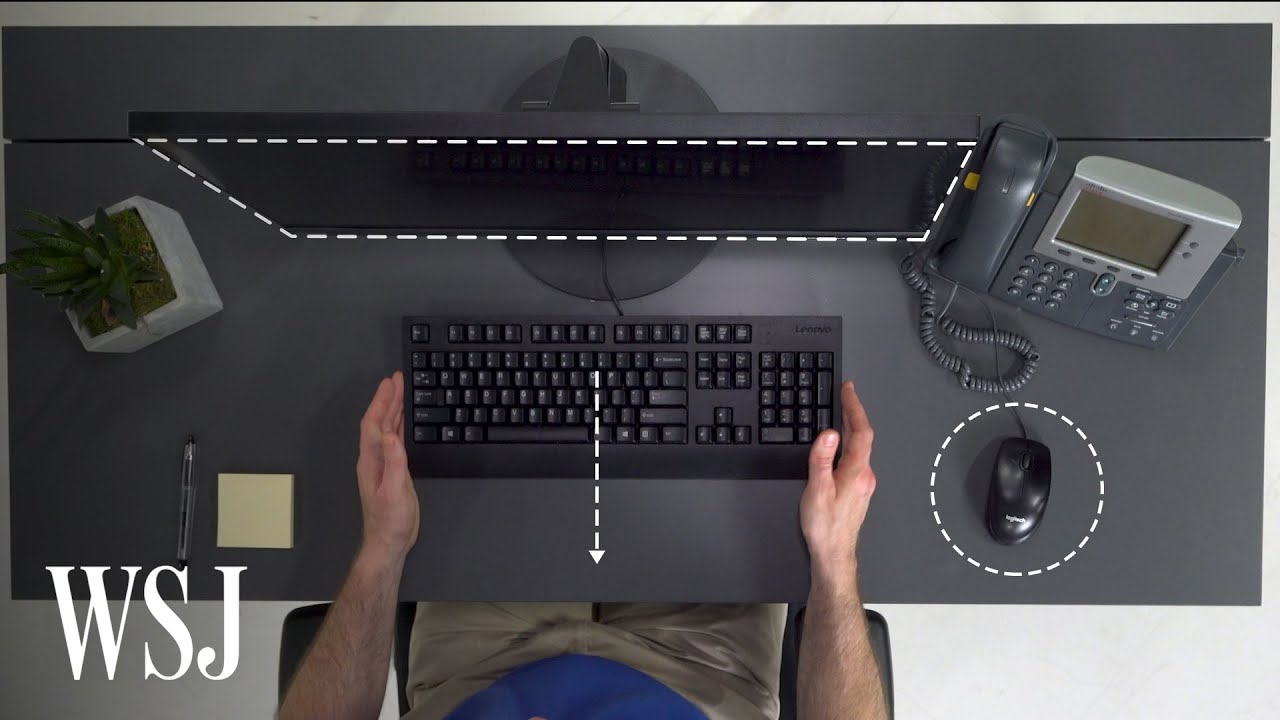
The last physical adjustment in Cinkay’s walkthrough is arrangement — keyboard, mouse, and desk phone should all sit close enough that reaching for them doesn’t require twisting the torso or extending the arm repeatedly. Repetitive reaching across a desk, he notes, is a quiet contributor to shoulder and back strain that most people never connect back to their equipment layout.
Cinkay closes the segment with a handful of simple stretches designed to be done right at the desk — quick enough to fit between meetings but enough to loosen the stiffness that builds up from sitting still, even in a properly adjusted chair.
None of this requires a new desk or a four-figure chair — Cinkay’s whole pitch is that the equipment most people already have can be reconfigured in a few minutes to stop doing damage. For anyone weighing whether it’s worth the tinkering, the calculus he lays out at HSS is straightforward: a 90-degree knee bend and an eye-level monitor cost nothing, while the alternative is the kind of chronic pain that eventually does.









5 KEYS TO BEING A GREAT DAY TRADER! RULES OF 36 YEAR VETERAN TRADER!
What is a Partnership?
Buying Rental Property with a Limited Liability Company (LLC)
Smart Online Shopping
Smart Online Shopping