

 InfoSearched
George Gilder wants Silicon Valley to know its biggest idea just hit a wall.
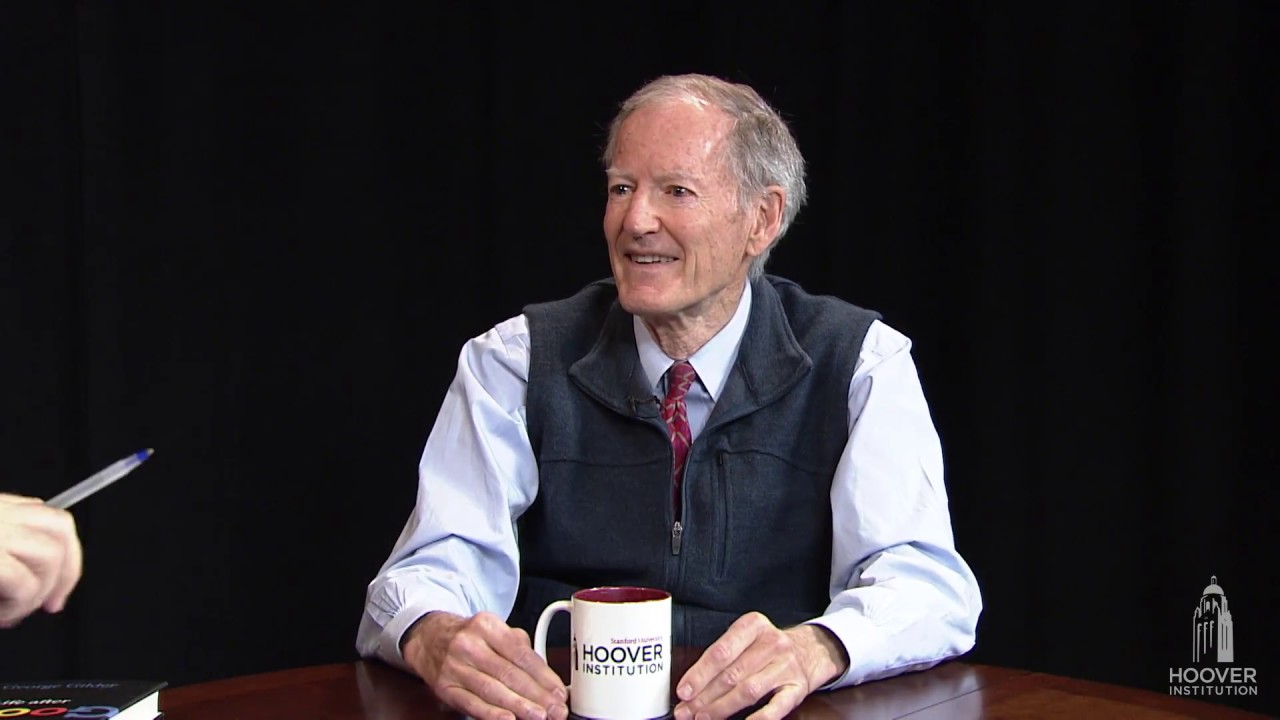
Twelve years after George Gilder wrote the Wired essay that helped talk the tech industry into the cloud, he showed up on Hoover Institution’s Uncommon Knowledge to tell host Peter Robinson he’d changed his mind. The occasion was Gilder’s nineteenth book, Life After Google: The Fall of Big Data and the Rise of the Blockchain Economy, and his argument is blunt: the centralized data-center model that runs Google, Facebook and Amazon is running out of room to grow, and blockchain is what replaces it.
- Gilder, who championed cloud computing in a 2006 Wired essay, now argues the model is hitting physical limits — pointing to Google’s data center in The Dalles, Oregon, one of roughly 80 such facilities worldwide built near dams and cold water for power and cooling.
- He cites figures showing about 30% of smartphone broadband costs go to loading unwanted ads, yet only 0.06% of those ads get clicked — half by accident — for a real engagement rate of just 0.03%.
- In place of centralized data silos, Gilder proposes a decentralized “cryptocosm” built on blockchain, drawing on Kurt Gödel’s incompleteness theorems and Alan Turing’s work to argue artificial intelligence can never replace human creativity.
The Cloud’s Physical Limits
Gilder’s pitch to Robinson starts by demolishing a metaphor. The “cloud,” he argues, is nothing ethereal — it’s a network of massive, factory-like data centers, and Google’s Dalles facility sitting on the Columbia River is exhibit one. Roughly 80 comparable sites operate globally, sited deliberately near dams and cold water because cooling servers and feeding them electricity are the real bottlenecks of the industry. Twelve years after he told Wired readers the cloud was the future, Gilder now tells Robinson that model has reached diminishing returns: parsing ever-larger pools of big data produces smaller and smaller improvements, while the physical infrastructure required to do it keeps getting more expensive to build and run.
Free Isn’t Free: The Advertising Math
The interview turns sharply critical when Gilder gets to Google’s business model — free services subsidized by digital advertising. He tells Robinson that “free” is a fiction that pushes the web back toward barter, and the numbers he cites back up the complaint. Roughly 30% of the data costs on a smartphone plan go toward loading ads nobody asked for.
Only 0.06% of smartphone ads ever get clicked — and half of those clicks are accidental, leaving real engagement at just 0.03%.
That’s the arithmetic Gilder uses to argue the ad-supported internet is structurally unsustainable, not just annoying. If a business model depends on users engaging with something they actively avoid at a rate approaching zero, he tells Robinson, it isn’t a business model — it’s a subsidy that’s running out of runway.
From Big Data to the Cryptocosm
Gilder’s replacement for the Google-era cloud is what he calls the “cryptocosm” — a decentralized architecture built on blockchain rather than centralized server farms. Instead of routing every transaction and every unit of data through Google’s or Amazon’s infrastructure, Gilder envisions “sky computing,” where individual smartphones and personal computers link up to process transactions themselves. Security, in his framing, stops being a patch bolted onto a finished system and becomes part of the architecture from the ground up. Readers interested in how that ledger mechanism actually works can find the mechanics laid out in Blockchain Explained, which walks through the same decentralized-ledger concept Gilder is applying to the entire internet.
The payoff Gilder describes to Robinson isn’t just architectural — it’s economic. A blockchain-based web, he argues, routes value directly to the people generating it instead of letting it pool in Silicon Valley’s ad-driven middlemen. That’s the same redistribution logic behind projects covered in How to make a cryptocurrency for less than $2, where cheap, permissionless token creation is framed as a direct challenge to centralized platforms controlling who gets paid.
Limitations of Machine Logical Reasoning
Robinson pushes Gilder on artificial intelligence, and Gilder’s answer leans on two mathematicians rather than Silicon Valley talking points. He invokes Kurt Gödel’s incompleteness theorems and Alan Turing’s foundational work on computation to argue that deterministic algorithms are structurally incapable of generating true creativity. A system that runs on fixed rules, in Gilder’s telling, can rearrange and optimize what it’s given, but it cannot originate the kind of insight that comes from a human mind operating outside those rules. That’s the intellectual foundation under his broader claim in Life After Google: big data and machine learning look powerful, but they’re bounded systems, and the future belongs to the people and networks that route around Google’s monopoly on parsing everyone else’s data.
Gilder doesn’t offer Robinson a timeline for when the cryptocosm actually displaces the cloud giants he spent 2006 promoting — his case is about direction, not a countdown clock. What’s clear from the Hoover conversation is that the same physical limits he once celebrated in Google’s server farms are now, in his telling, the very thing blockchain’s decentralized model is built to route around.






Why Millennials Love Gucci
What is Blockchain Technology? (In Simple Terms)
Matthew McConaughey | 5 Minutes for the NEXT 50 Years of Your LIFE
Is This The Billionaire’s Shortcut? (The Real Life NZT)
How to Pick the Perfect Domain Name