

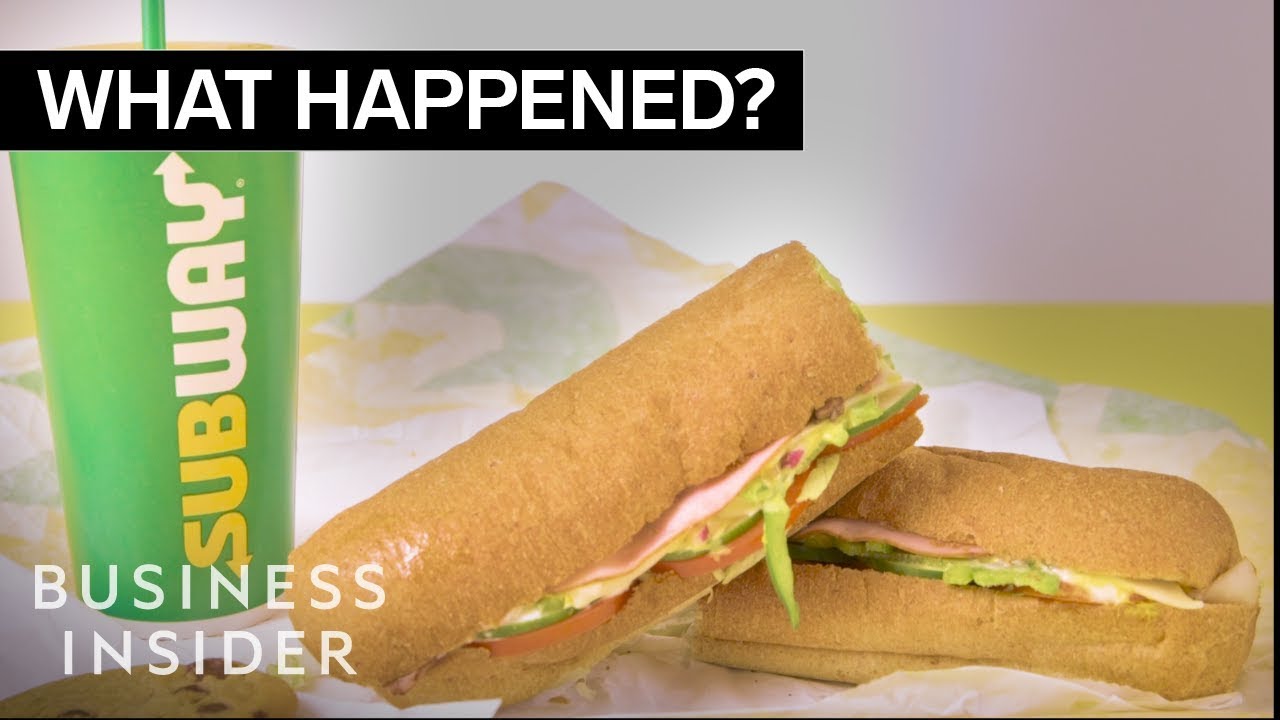
 InfoSearched
Subway didn’t lose to a rival burger chain or a health-food upstart — it got eaten alive by its own franchise map.
Business Insider’s video breakdown, “The Rise And Fall Of Subway,” traces how the world’s largest restaurant chain by store count went from a 17-year-old’s sandwich shop in Bridgeport, Connecticut, to a company shuttering more than a thousand U.S. locations a year. The arc runs from a $1,000 loan in 1965 to over 44,000 stores in more than 110 countries, and then, just as fast, into a stretch of shrinking sales and franchisee revolt. The video lays out the numbers behind both halves of that story.
- Fred DeLuca opened “Pete’s Super Submarines” in 1965 with family friend Peter Buck, rebranded it Subway in 1968, and built the low-cost 1974 franchising model that let it pass 44,000 locations in 110-plus countries.
- Subway collected 8% royalties and 4.5% advertising fees from every store regardless of profitability, while aggressive franchising packed locations close enough together to cannibalize each other’s sales.
- U.S. sales fell to $11.3 billion by 2016, and the chain closed 909 domestic stores in 2017 and more than 1,000 more in 2018 as Panera, Chipotle and Jersey Mike’s pulled customers away.
From Pete’s Super Submarines to a Global Franchise Machine
DeLuca was a teenager looking to pay for college when Buck put up the money to open that first sub shop in 1965. Three years later the name changed to Subway, and by 1974 the pair had figured out the piece that mattered most: a franchising model that skipped the fryers, grills, and expensive kitchen buildouts competitors like McDonald’s required. That kept startup costs low enough that Subway could plant locations almost anywhere — inside gas stations, strip malls, even Walmarts — and the store count exploded past 44,000 across more than 110 countries.
The partnership between DeLuca and Buck, and later the family control that followed it, is a reminder that even a franchise juggernaut runs on the same fault lines as any two-person business partnership — succession and trust matter as much as the product.
Jared Fogle and the $5 Footlong
Two marketing bets turned Subway into a cultural fixture. The first was Jared Fogle, the spokesperson who claimed to have lost more than 200 pounds eating Subway sandwiches and became the face of the “healthy fast food” pitch for over a decade. The second was the $5 Footlong, a promotion that went viral after its 2008 launch and trained an entire generation of customers to expect a footlong sub for five bucks — a price point that would later come back to bite the company.
Franchise Models Collapse Under Internal Pressure
The same low-cost setup that fueled Subway’s growth became the mechanism of its decline. Corporate kept collecting its 8% royalty and 4.5% advertising fee no matter how a given store performed, while franchisees dealt with thinning margins as ingredient costs climbed and the $5 Footlong price stuck around far longer than it should have. Worse, Subway’s expansion strategy often put new franchise locations within blocks of existing ones, cannibalizing sales rather than growing the overall customer base.
Subway kept collecting 8% royalties and 4.5% advertising fees from every store — whether that store was making money or not.
That dynamic is the exact trap that Mark Cuban has warned entrepreneurs about when a business model rewards headquarters no matter what happens at the store level — the incentives stop lining up between the corporation and the people actually running the locations.
Scandal, a Cofounder’s Death, and Mounting Closures
The reputational damage piled up fast. In 2013, viral photos of footlong sandwiches measuring under 12 inches sparked a consumer backlash over false advertising. Then in 2015, Fogle was arrested and later convicted on federal child pornography charges, gutting the brand’s decade-long “healthy guy who lost 200 pounds” pitch. Cofounder Fred DeLuca died that same year, handing leadership to his sister, Suzanne Greco, right as franchisee unrest over fees and cannibalized sales was intensifying.
By 2016, U.S. sales had slipped to $11.3 billion. Subway responded not with a turnaround plan but with retrenchment — 909 store closures in 2017, followed by more than 1,000 in 2018 — as fast-casual competitors like Panera, Chipotle, and Jersey Mike’s captured customers looking for fresher, less processed options than Subway’s decades-old formula.
The math that built Subway’s empire — cheap franchises, dense store networks, a fee structure that paid corporate first — is the same math that emptied out its store count once the growth stopped. More than 1,000 U.S. locations closed in 2018 alone, and the chain that once out-numbered McDonald’s worldwide was still figuring out how many of its own stores it needed to shut down just to stop bleeding sales.








Having a Business Partner vs Going Solo
5 KEYS TO BEING A GREAT DAY TRADER! RULES OF 36 YEAR VETERAN TRADER!
How to Find and Buy a Foreclosed Home
How To Save Money On Google’s Adwords
Peterson Speaker Series – Hybrid Organizations | December 3, 2015